Meet Simply Bread Co customer Kevin Grenz (@MeloBread)
The Importance of Baking in a Stone Deck Oven
By Alisha Fuller
When people talk about improving bread quality, the conversation usually centers on flour, hydration, fermentation timing, or shaping technique. Those variables matter, and any serious baker will tell you they spent real time dialing each one in. But there is a point where you can have all of those things working and still feel like something is off, like the ceiling keeps moving no matter how much you refine.
That was exactly where I was when I started my micro bakery.
I was baking out of my home oven. Open bake, a steel, cast iron pans, and water for steam. The loaves were decent, something I was genuinely proud of, but I could only fit four at a time and the process was exhausting. My oven didn't hold steam well, so I used a lot of water, which stripped my cast iron and added scrubbing time to every single bake. There were hot spots. The ears weren't peeling the way I wanted. The belly pop wasn't there. I knew my dough was good. The oven just wasn't baking it.
When I got invited to a farmers market, the limit became impossible to ignore. I sold out every time. The demand was there. The business was real. But I couldn't meet it, because time is the one thing you can't buy more of, and my oven was eating all of it.
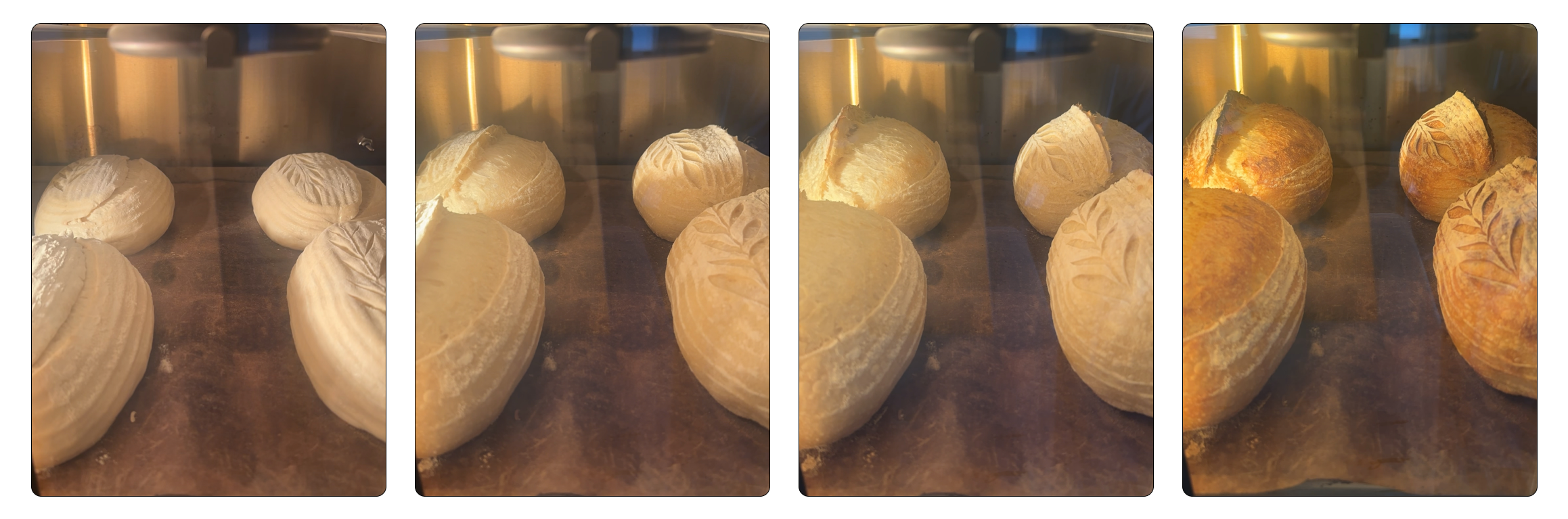
After seeing the Simply Bread oven online, my husband and I sat down, crunched the numbers, and made the call. My first bake I pulled twelve loaves in just under thirty five minutes and I cried. Genuinely cried.
Heat Is the Final Ingredient
Fermentation develops internal structure gradually. It produces gas, strengthens gluten, builds acidity, and shapes flavor over hours. Heat finalizes that work in minutes. During the early stage of baking, starch gelatinizes and proteins coagulate while fermentation gases expand rapidly. The dough is still elastic when it enters the oven. Expansion is still underway. The manner in which energy moves into the loaf during this window determines how that expansion sets.
How Heat Moves in an Air-Based Oven
In most residential ovens, heat is created by elements that warm the air inside a relatively thin metal cavity. The oven cycles those elements on and off to maintain a target reading. Because air does not store large amounts of energy, the system depends on continuous reheating to remain near its set temperature. When the door opens, warm air escapes quickly. When cold dough enters, the temperature drops and begins climbing again.
Heat transfer here follows a sequence. The air warms first, then transfers energy to the surface of the dough, and only then does heat begin moving inward toward the center. Any fluctuation in the surrounding air affects that progression directly.
Many bakers learn to manage this rhythm intuitively. They rotate loaves, adjust bake times, and develop a feel for how their oven behaves on different days. These adjustments become part of the craft. But compensation is not the same as control, and there is a difference between managing a variable and removing it.
How Heat Moves in a Stone Deck Oven
A stone deck oven introduces a different thermal dynamic because it stores energy within solid mass. During preheat, the deck stones absorb heat and hold it internally. The energy is held within the mass of the stone itself rather than existing primarily as heated air circulating within the chamber. When dough is placed directly on the deck, energy transfers immediately through conduction. The base of the loaf receives direct contact heat from a charged surface.
This early transfer is critical. Starch gelatinization begins at the point of contact. The structure at the base firms quickly enough to support vertical expansion as internal gases continue to expand. The loaf builds upward with greater stability because the foundation is being set by direct energy transfer.
Thermal mass also creates continuity. Once charged, the stones release energy steadily. Heating elements continue feeding heat into the system during the bake cycle, allowing the oven to stabilize between loads. That predictability is one of the defining advantages of a deck system, and it is the reason batch two behaves like batch one.
What This Means for Structure, Crumb, and Crust
When heat enters the dough through stored mass, structural development changes in three consistent ways.
Oven spring develops with more clarity. The base sets in coordination with internal expansion, encouraging lift rather than lateral spread. Scoring opens cleanly because the surface remains flexible long enough for full expansion before firming.
Crumb structure reflects fermentation more honestly. Because the thermal environment is stable, the internal cell structure reveals the true state of proof. Slight adjustments in bulk timing or inoculation rate become visible and correctable, which is exactly what makes a deck oven one of the most effective teaching tools a serious baker can have.
Crust development becomes more consistent. Steam management during the early bake allows expansion without premature setting, and the steady release of dry heat afterward supports even caramelization and color development across every loaf, not just the first one out.
The Oven Makes You a Better Baker
There can be a learning curve when going from home oven baking to a stone deck oven. A stable stone deck oven is going to immediately expose any flaws in our process: fermentation, shaping, the way we score. If our process isn't on point before loading the dough into the oven, the dough will show us exactly where our issues are.
In a Dutch oven, there is an inherent lag. You pull it out of the oven, load the dough, and in that transfer time heat escapes. The environment takes a moment to rebuild. For underfermented dough, that lag actually creates a window where the CO2 has more time to expand before the structure sets, which can mask the problem and produce a decent looking loaf even when fermentation was not quite there.
A stone deck oven does not give you that window. The stored energy in the stones begins transferring into the dough the moment it makes contact with the surface. There is no lag, no recovery period, no accidental assist. The dough goes in and the heat responds immediately, which means the loaf has to stand on its own. If fermentation is where it needs to be, that shows up. If it is not, that shows up too. Underproofed dough often comes out flatter because there was not enough gas development to support the rise. Overproofed dough can do the same, the structure has already weakened by the time it hits the heat and does not have the strength to hold the expansion.
That honesty can be uncomfortable at first. But it is exactly what makes us better. When the oven is no longer the variable that gives us different bakes, our process has to sharpen. We start paying closer attention to bulk timing, to how the dough feels, to what the crumb is telling us after each bake. We dissect things differently. Our intuition sharpens. And over time, every bake teaches us something new.
Baking Stones Are Meant To Be Baked On
Baking stones are meant to be baked on directly, and that is true for everything that goes into this oven, not just bread. We often think cookies, croissants, cinnamon rolls, scones, bagels, and rolls must have a pan in order to bake them properly since that is what we are used to in a home oven. The beauty though is that all of these things can be baked right on the stone. The direct contact with that steady stored heat is what gives everything a golden, even bottom that feels almost effortless once you experience it for the first time.
For anything messy where spills, leaking, or excess butter are likely, silicone baking mats are a great option. You can also bake directly on the stones if you choose not to use anything at all.
Time, Efficiency, and What It Actually Costs to Run
Because thermal mass stores and releases energy steadily rather than continuously rebuilding from reheated air, the oven works efficiently once it is charged. Bake times on a true deck system typically run ten to fifteen minutes shorter than what most bakers are used to in a residential oven. Across a full production day that difference compounds into real capacity.
More output in the same window of time means less compression during busy periods and more predictable scheduling.
Lower energy draw because once the stones are charged the system runs from stored mass rather than constant reheating, which is better for your power consumption over the long run.
The Oven Changed Everything
I bought the Simply Bread oven because I needed to bake more bread. What it gave me was so much more than capacity.
It gave me time back. It gave me the freedom to play, to experiment, to dial things in and actually see the results clearly. It opened doors I didn't know were there. More bread meant more people to serve, a business that could actually grow, and a process I finally understood at a level I hadn't reached before.
That first bake changed everything for me. I pulled twelve loaves in just under thirty five minutes and felt it hit me all at once. For the first time, I could see what was possible.
That’s what a stone deck oven does. It doesn’t just bake bread. It changes what baking can be for you.
Join the Simply Bread Community
Read about unique artisan bakers’ stories and latest recipes, and connect with the baking community. We will even notify you about our exclusive promotions, new product releases, oven software updates, and more.




.png)


.webp)
.webp)
