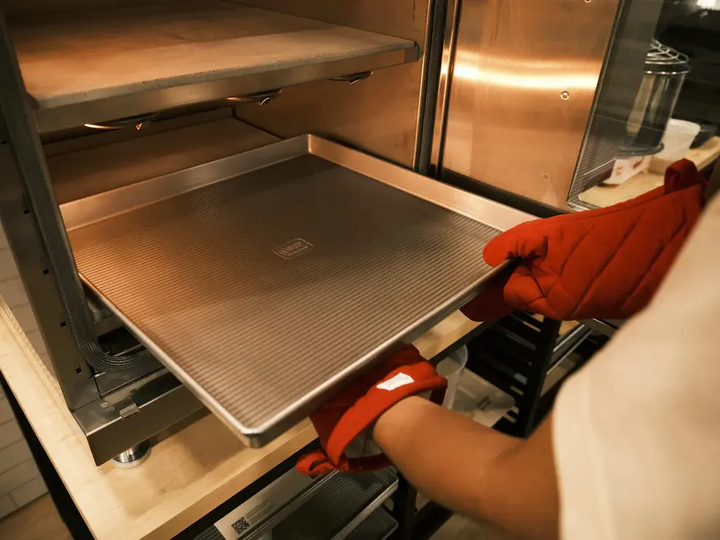
Understanding what pans actually do brings clarity to the baking process. When pan choice is intentional, the bake is guided by the result you want to achieve. Different pans interact with heat in different ways, and knowing how that interaction works allows the setup to support the bake from the start.
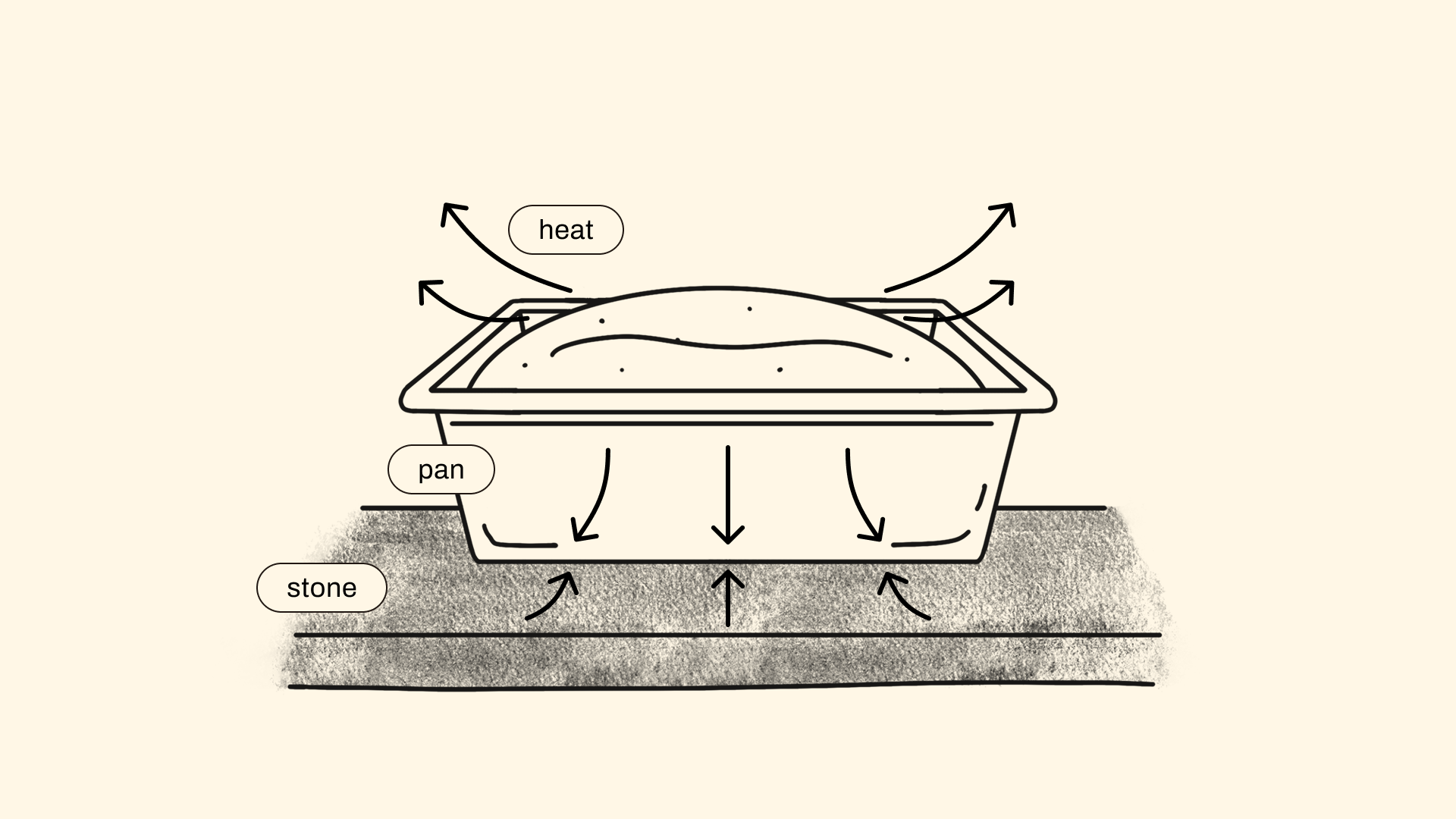
In a stone deck oven, heat is stored in the stones and released upward into the bake, supplying steady bottom heat as soon as dough is placed on the deck. A metal pan, especially a room-temperature one placed between the hot stone and your dough, will act as a heat shield. This heat shield can increase the time it takes for heat to reach your dough and diffuse heat across the pan.
The impact of the pan on heat transfer is dependent on the size, thickness, shape, and material of the pan, and all of these factors play a role in achieving a consistent, predictable result in your bake.
Many bakers use aluminum pans because they’re lightweight and really good at conducting heat. Aluminum heats quickly and delivers even heat across the surface, though its fast transfer can lead to quicker bottom color without buffering.
For sandwich loaves and other structured breads, bakers often choose aluminized steel or heavier steel pans. Steel is much denser than aluminum, absorbing and distributing heat more gradually, and providing a slower yet sustained heat transfer. This can help prevent premature browning on the bottom of your dough.
Some bakers prefer stainless steel loaf pans for durability and long service life. However, stainless steel conducts heat less effectively than aluminum and holds less heat than heavier steel pans, meaning bakes with these pans often require higher temperatures.
Smaller pans and cookie sheets are commonly used for brownies, cookies, scones, bars, and other flat bakes. They’re often chosen for ease of handling, consistency across batches, or to introduce a slight buffer between the dough and the stone. Pan size and thickness still influence how quickly heat is absorbed and how evenly color develops.
For oil rich doughs like focaccia, heavier gauge pans are often preferred. Aluminized steel focaccia pans distribute heat evenly, supporting a crisp, well colored bottom without overbaking the interior. That same balance applies to larger batch pans, where added mass helps moderate direct stone heat across a wider surface.
As pans get larger, the effects of heat transfer become more visible. Parts of the pan closer to the stone will heat up faster, while the raised parts of the pan receive heat more gradually. Because metal expands as it heats up, this unequal heat transfer sometimes leads to flexing. Flexing during baking typically isn’t permanent or detrimental to your pan, but instead could point to improper usage.
This type of behavior is most noticeable when a pan is filled unevenly during a bake, or loaded with a lightweight bake that doesn’t weigh the pan down properly. When a large pan isn’t adequately weighted by the bake itself, heat from the stone can cause the pan to expand or flex unevenly as it warms. Because the bake on top of the pan is light, it moves with it. Items like small pies, tarts, or individual portions can slide toward the center of the pan as it settles, even though the oven is level.
Large pans tend to work best when the bake itself provides enough weight and coverage to stabilize the surface. Batch bakes like cookies, bars, slab bakes, rolls, buns, and focaccia benefit from the even heat distribution a large pan provides. When the pan is properly loaded, the added mass helps heat settle evenly across the surface and supports consistent results from edge to edge.
Some bakes simply do not need the added buffer of a large pan. Items like pies, for example, already benefit from direct stone heat to set the crust efficiently. Introducing a large sheet pan can slow that process and, depending on the size and load, introduce unnecessary movement during the bake.
If used at all for a bake, pans should be chosen intentionally to accomplish a goal. In a stone deck oven, pans can help you accomplish a few goals:
Note: Putting pies or muffins, which are already in their own tins, onto a baking pan can make it easier to load/unload. However, this adds an additional barrier for heat transfer, and smaller tins can easily slide around on the pan as it flexes.
Pan choice in a stone deck oven works best when it’s intentional. Each pan contributes something specific to the bake, whether that’s structural guidance, heat moderation, or ease of handling during production.
When the role of the pan aligns with what the dough needs, the bake behaves predictably and consistently. Understanding how pans change the heat path makes it easier to choose a setup that supports structure, timing, and final texture.
Results matter most. When a setup is producing outcomes you’re happy with, it’s working. Knowing why it works gives you the flexibility to repeat it confidently or adjust when a different approach better serves the bake.


.png)


.webp)
.webp)
